
How to Adjust the Depth Skid (Hitch Bar) on Power Weeders for Effortless Control
The single most misunderstood adjustment on a power weeder: how the depth resistance rod controls forward speed and tilling depth without operator muscle strain.
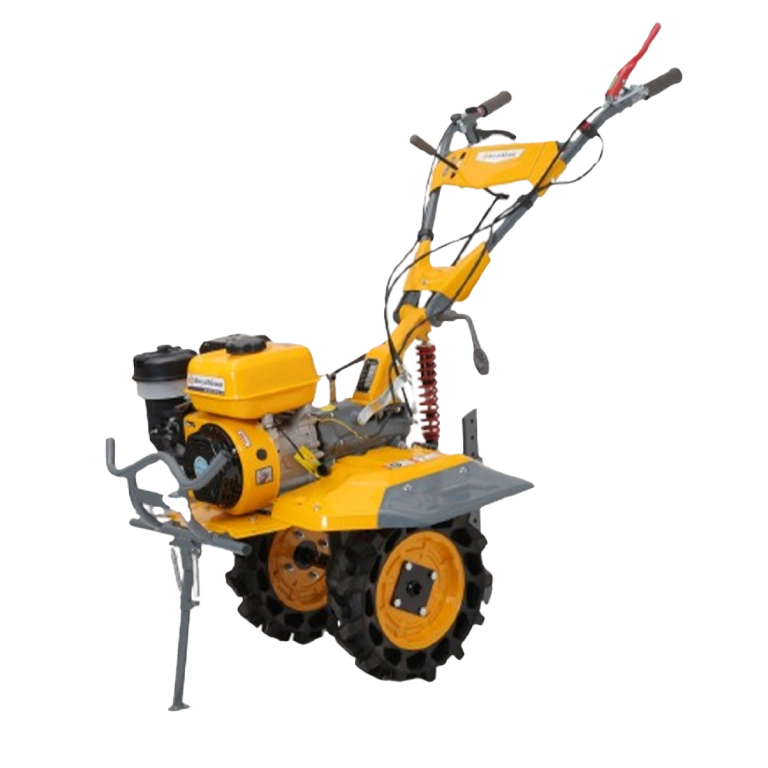
Novice operators fight the power weeder by pushing down with their arms to force the blades into the ground, leading to exhausted shoulders within 15 minutes.
The Secret: Let the Depth Skid Do the Work!
The depth skid (the curved steel bar trailing behind the gearbox) is not a stand—it is a brake.
- •When you press down lightly on the handlebars, the depth skid digs into the subsoil.
- •This creates backward drag, holding the machine in place while the spinning blades churn deep into the earth.
- •When you lift the handlebars slightly, the skid rises, and the blades pull the machine forward.
Correct Adjustment
- •Hard, Compacted Soil: Set the depth skid low so it provides strong braking resistance, allowing blades to dig 6–8 inches deep.
- •Light, Sandy Soil or Shallow Weeding: Raise the depth skid so the machine moves forward faster without digging too deep into root zones.
Technical Engineering Context & Field Dynamics
Power weeders and intercultivators are the backbone of row-crop weed management in sugarcane, cotton, vegetables, ginger, and turmeric across India. Operating in harsh dusty fields under high ambient temperatures (35°C–45°C), these machines undergo heavy continuous thermal and mechanical stress. Addressing issues promptly with OEM-spec tolerances prevents catastrophic engine seizures and costly transmission gear fractures.
Factory Tolerance & Recommended Maintenance Matrix
| Specification / Inspection Parameter | Standard OEM Value | Tolerance Limit / Replacement Trigger |
|---|---|---|
| Engine Oil Viscosity & Grade | 20W-40 4T API-SL (0.6L for 7HP Petrol, 1.1L for KG- Diesel) | Change every 50 operating hours; replace immediately if blackened |
| Transmission Gearbox Oil | SAE 90 or 85W-140 Heavy Duty Extreme Pressure Oil | 1.8L to 2.2L capacity; inspect level weekly via check bolt |
| Spark Plug Gap (Petrol Engines) | 0.70 mm – 0.80 mm (Torch F7RTC / NGK BPR6ES) | Replace spark plug every 100 hours or when electrode erodes >0.90 mm |
| Carburetor Float Height & Needle Tip | 17.0 mm float height; Viton rubber-tipped needle | Replace needle valve if tip shows groove wear or fails seal test |
| Piston Ring End Gap | 0.20 mm – 0.35 mm | Replace rings if end gap exceeds 0.65 mm inside bore |
OEM Spare Parts & Workshop Specifications
For agricultural workshops, mechanics, and equipment dealers across India, maintaining accurate engineering tolerances is vital. When replacing worn mechanical assemblies, always ensure parts meet certified metallurgical and dimensional standards:
- •Surface Hardening: Cultivator tines, auger tips, and drive shafts must carry induction hardening (HRC 48–52) to resist abrasion in quartz and gravel soils.
- •Viton Seals: Use double-lip Viton oil seals on rotor output shafts to withstand high soil friction and prevent oil contamination.
- •Genuine Fitment Guarantee: KrishiGears provides fitment-verified spare parts for all standard 7HP, 9HP petrol engines, KG-/186F diesel models, and 52cc/63cc 2-stroke equipment with PAN-India express dispatch.
Frequently Asked Field Questions & Expert Answers
Q: What is the correct engine oil change schedule for power weeders?
Expert Resolution: First oil change must be performed at 5 to 8 running hours (break-in period) to flush out factory machining metal dust. Subsequent changes should occur every 45 to 50 field hours using genuine 20W-40 4T oil.
Q: Why does my power weeder slip gears or pop into neutral during tilling?
Expert Resolution: Gear slippage is typically caused by stretched shift linkage cables, worn dog clutch teeth on the transmission shaft, or weakened detent ball springs inside the selector fork assembly.
Q: Can I run ethanol-blended E20 petrol in power weeders?
Expert Resolution: Standard small engines tolerate up to 10% ethanol. E20 petrol causes accelerated degradation of rubber float needle tips, fuel hoses, and aluminum bowl oxidation if left stagnant. Always install a brass-mesh in-line filter and drain the carburetor bowl before multi-week storage.
Direct B2B Dispatch & Fitment Confirmation
Contact our engineering and dispatch desk in Jaipur for original carburetor jets, recoil assemblies, blade sets, and gearbox components.